Key Takeaways
- A vulnerability assessment identifies security weaknesses.
- Penetration testing attempts to safely exploit weaknesses to prove real-world risk.
- Vulnerability assessments are usually broader and done more often.
- Penetration tests are deeper, more targeted, and often used for high-risk systems or compliance needs.
- Small businesses should usually start with a vulnerability assessment before moving into penetration testing.
- Many businesses benefit from using both as part of a complete cybersecurity strategy.
A vulnerability assessment identifies security weaknesses in your systems, networks, applications, or devices. Penetration testing goes a step further by safely attempting to exploit those weaknesses to understand how an attacker could use them.
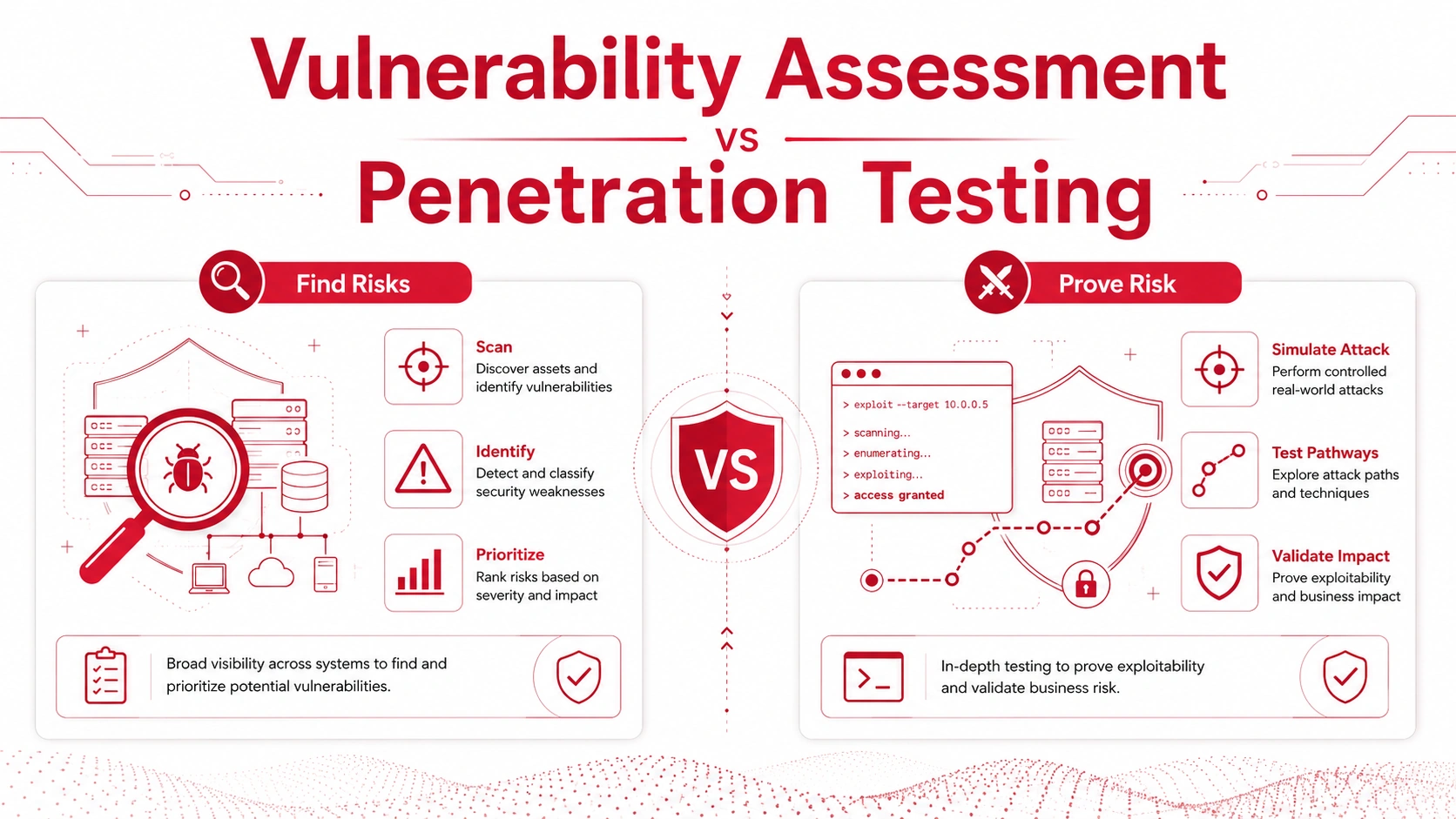
Both are useful, but they are not the same. A vulnerability assessment helps you find and prioritize risks. Penetration testing helps prove which risks could create real-world damage.
Vulnerability Assessment Finds Risks, Penetration Testing Proves Them
A vulnerability assessment is a broad security review. It looks for known weaknesses, misconfigurations, outdated software, and other security gaps.
Penetration testing is a deeper, more targeted test. It simulates how an attacker might try to access your systems, move through your network, or expose sensitive data.
| Security Test | Main Purpose | Best For | Output |
| Vulnerability Assessment | Find and prioritize weaknesses | Routine security reviews | List of vulnerabilities and recommended fixes |
| Penetration Testing | Test whether weaknesses can be exploited | High-risk systems or compliance needs | Real-world attack simulation report |
For many businesses, the best approach is not choosing one over the other. It is using both as part of a stronger cybersecurity strategy.
What Is a Vulnerability Assessment?
A vulnerability assessment is a security review that checks your IT environment for weaknesses. It is often used to identify problems before attackers can take advantage of them.
A vulnerability assessment may check for:
- Missing software patches
- Weak passwords
- Misconfigured systems
- Outdated applications
- Open ports
- Unsecured devices
- Cloud security gaps
- Network vulnerabilities
The goal is to create a clear list of risks and prioritize what should be fixed first. For example, a critical server vulnerability would usually need attention before a low-risk issue on a less important device.
Vulnerability assessments are useful because they give businesses better visibility into their security posture. They help answer an important question: “Where are we exposed right now?”
What Is Penetration Testing?
Penetration testing, often called pen testing, is a controlled security test that simulates how an attacker might try to break into your systems.
Instead of only identifying weaknesses, penetration testing attempts to use those weaknesses in a safe and controlled way. This helps show what could happen if a real attacker found the same issue.
Penetration testing may involve:
- Network testing
- Web application testing
- Cloud environment testing
- Remote access testing
- Social engineering testing
- Internal system testing
The goal is to understand real-world business risk. For example, a vulnerability assessment may show that a system has a security weakness. A penetration test may show whether that weakness could actually be used to access sensitive data.
Because penetration testing is more hands-on, it should be performed carefully by qualified security professionals.
Vulnerability Assessment vs Penetration Testing: Key Differences
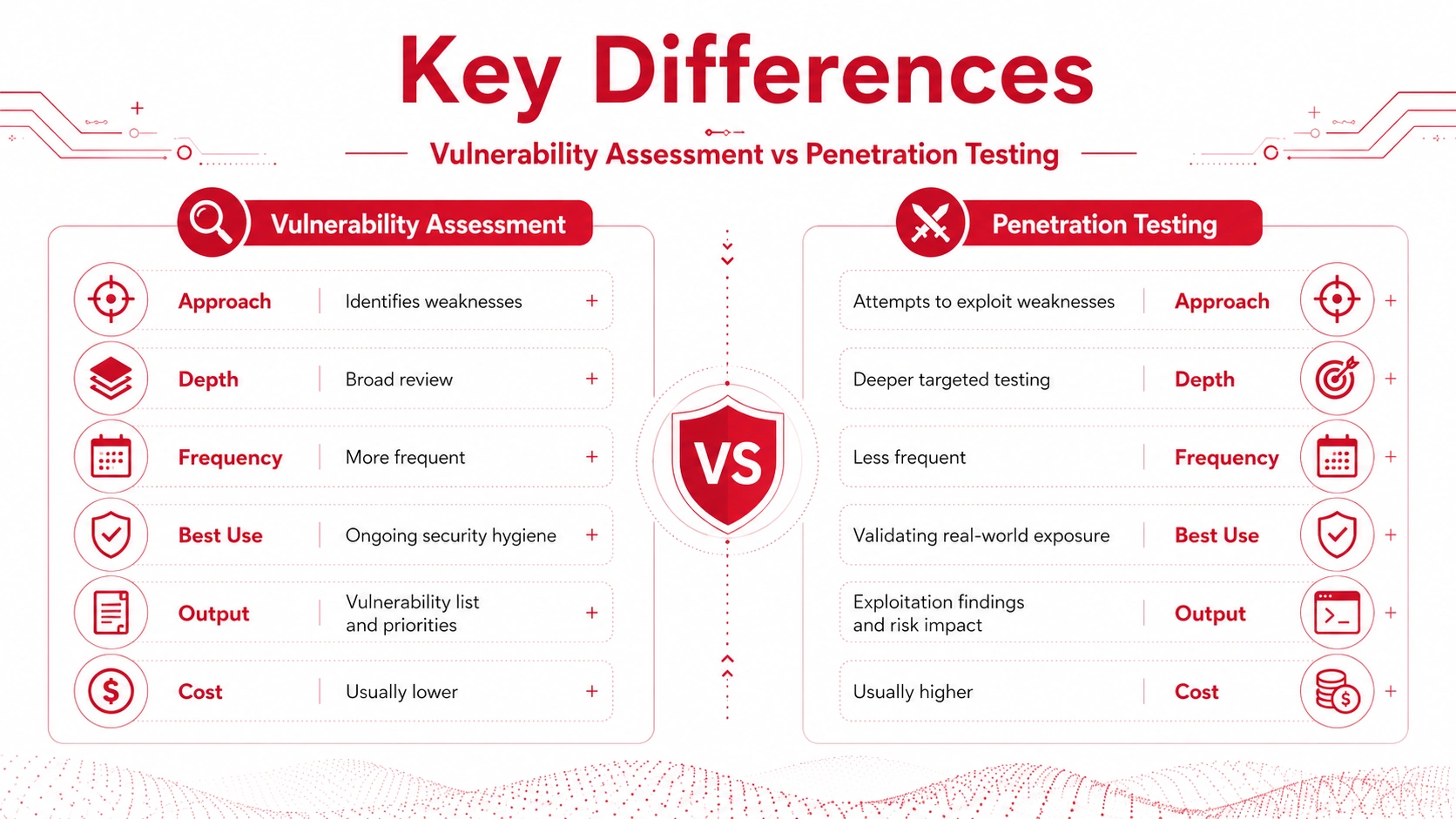
The main difference is depth. A vulnerability assessment identifies potential risks. Penetration testing validates whether those risks can be exploited.
| Category | Vulnerability Assessment | Penetration Testing |
| Approach | Identifies weaknesses | Attempts to exploit weaknesses |
| Depth | Broad review | Deeper targeted testing |
| Risk level | Lower impact | More controlled risk |
| Frequency | More frequent | Less frequent |
| Best use | Ongoing security hygiene | Validating real-world exposure |
| Output | Vulnerability list and priorities | Exploitation findings and risk impact |
| Cost | Usually lower | Usually higher |
| Goal | Find what needs fixing | Prove what an attacker could do |
A vulnerability assessment is usually the better starting point if your business does not have a clear view of its security risks. Penetration testing is more useful when you need to confirm whether critical systems can withstand real attack methods.
When Should You Use a Vulnerability Assessment?
A vulnerability assessment is useful when your business needs a routine security check or wants to understand where its systems may be exposed.
You should consider a vulnerability assessment if:
- You have not reviewed your security in a while
- You recently added new software or devices
- You moved systems to the cloud
- You need to identify patching gaps
- You want to prioritize security fixes
- You are preparing for a more advanced security test
- You need visibility across your IT environment
This type of assessment can be especially helpful for businesses that use cloud platforms, remote work tools, or multiple connected devices. If your systems are changing often, regular assessments can help you catch issues early.
A vulnerability assessment also works well alongside managed IT support, because the findings can guide patching, updates, monitoring, and system improvements.
When Should You Use Penetration Testing?
Penetration testing is useful when your business needs a deeper understanding of how attackers could exploit your systems.
You should consider penetration testing if:
- You handle sensitive customer, financial, healthcare, or legal data
- You need to validate your security controls
- You are launching a new application or system
- You are preparing for compliance or vendor reviews
- You experienced a security incident
- You want to understand how an attacker could move through your systems
- You need executive-level proof of security risk
Penetration testing is often used for higher-risk systems or situations where a business needs more than a list of vulnerabilities. It helps show the possible impact of a weakness, not just its existence.
For example, if your business uses cloud infrastructure, a penetration test may help confirm whether access controls, permissions, and configurations are protecting sensitive data properly. This can be especially important after a major cloud migration or system change.
Do Small Businesses Need Both?
Small businesses may not need penetration testing as often as larger organizations, but they should still take security testing seriously.
A vulnerability assessment is a good starting point for most small businesses. It helps identify common security gaps, outdated systems, missing patches, and configuration issues. These are often the same weaknesses attackers look for first.
Penetration testing may also be necessary if the business:
- Handles sensitive customer data
- Works in a regulated industry
- Uses cloud systems heavily
- Supports remote employees
- Stores financial, legal, or healthcare information
- Needs to meet vendor or compliance requirements
For many small businesses, the best approach is to perform vulnerability assessments more regularly and schedule penetration testing after major changes, before important launches, or as part of annual security planning.
Which One Should Your Business Choose First?
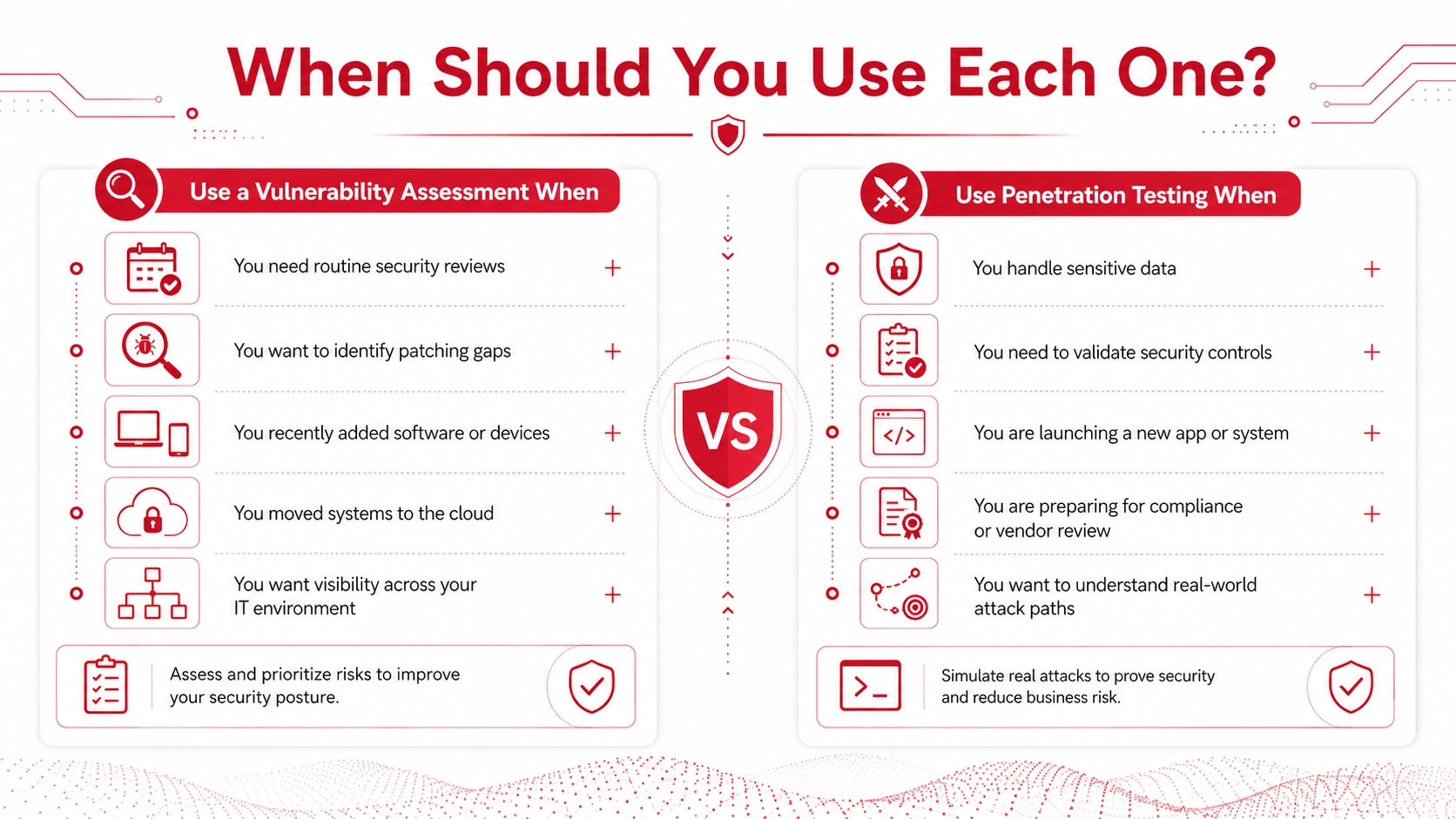
Start with a vulnerability assessment if you do not already have a clear view of your security risks. It gives your business a practical list of what needs to be fixed.
Once the most important issues are addressed, penetration testing can help confirm whether your security controls are working against real-world attack methods.
| Situation | Better Starting Point |
| You have not reviewed your security in a while | Vulnerability assessment |
| You need to find patching and configuration gaps | Vulnerability assessment |
| You need to prove whether attackers can gain access | Penetration testing |
| You are preparing for compliance or vendor review | Penetration testing |
| You want an ongoing security improvement plan | Vulnerability assessment first, then penetration testing |
If your business is unsure where to begin, a cybersecurity assessment is usually the most practical first step. It helps create a clearer picture before moving into more advanced testing.
How Vulnerability Assessments and Penetration Testing Work Together
Vulnerability assessments and penetration testing are strongest when used together.
A vulnerability assessment helps identify what needs attention. Penetration testing helps confirm whether the most serious weaknesses could be exploited. Together, they give your business a clearer view of both technical issues and real-world risk.
A simple process can look like this:
- Run a vulnerability assessment.
- Prioritize and fix high-risk issues.
- Perform penetration testing on critical systems.
- Review the findings.
- Improve security controls.
- Retest when needed.
This process helps your business move from simply finding risks to actually reducing them.
It can also support related areas like access control, cloud security, backup planning, and data backup and disaster recovery, especially if your business needs to stay operational after a cyberattack or outage.
Need Help Finding and Fixing Security Weaknesses?
Adivi helps businesses identify cybersecurity risks, strengthen IT systems, and reduce exposure to cyber threats. Whether your business needs a vulnerability assessment, a security review, or broader cybersecurity services, Adivi can help you build a safer and more resilient IT environment.
Schedule a free assessment with Adivi to find the right cybersecurity approach for your business.
FAQs
What is the difference between vulnerability assessment and penetration testing?
A vulnerability assessment identifies and prioritizes security weaknesses. Penetration testing attempts to exploit those weaknesses in a controlled way to show how an attacker could use them.
Is vulnerability assessment the same as penetration testing?
No. A vulnerability assessment finds possible risks, while penetration testing validates whether those risks can actually be exploited.
Which is better: vulnerability assessment or penetration testing?
Neither is always better. A vulnerability assessment is better for routine security reviews, while penetration testing is better for proving real-world risk on critical systems.
How often should businesses do vulnerability assessments?
Many businesses should perform vulnerability assessments regularly, especially after major system changes, software updates, cloud migrations, or security incidents.
Do small businesses need penetration testing?
Some small businesses do, especially if they handle sensitive data, need compliance support, use cloud systems, or want to validate the strength of their cybersecurity controls.